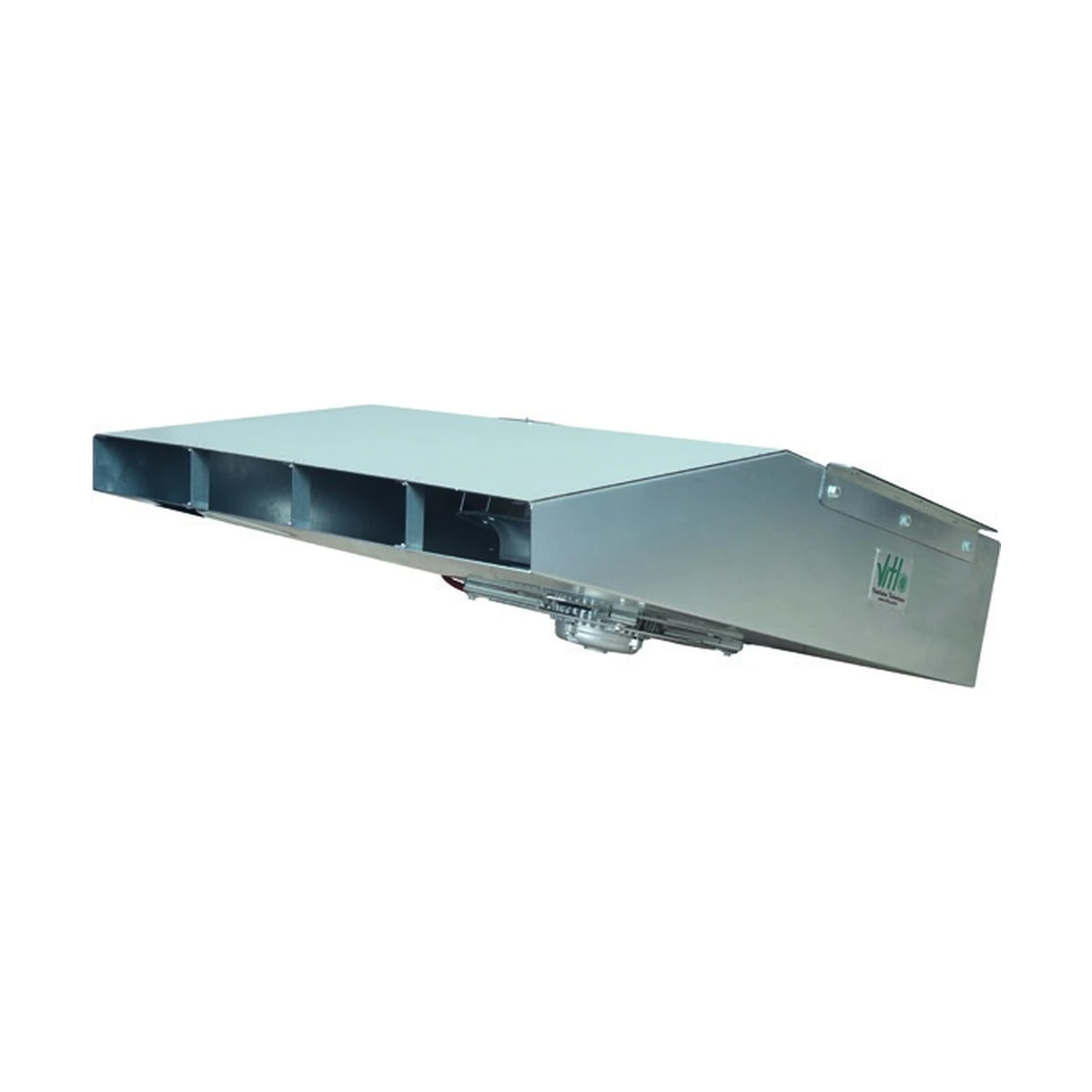
RXJ Radial Jet Fan
Radial jet fan series for smoke control in car parks and enclosed spaces.
Product Features
- General
It has high-efficiency radial backward-curved blades.
- General
Fan casing and fittings are made of galvanized steel sheet.
- General
The backward-curved radial impeller is made of corrosion-resistant galvanized material.
- General
For S1 normal ventilation it is suitable for continuous operation from -20°C to +55°C.
- General
For S2 fire mode, 300°C/2h and 400°C/2h options are available.
- General
Wire mesh on the suction side and a deflector on the discharge side are standard.
- General
The fan is certified according to EN 12101-3:2015.
- Motor
The motor is IP55 protected, IE2/IE3 high efficiency, fully enclosed, with self-lubricating bearings and H insulation class.
- Motor
Depending on model, 4/8 and 4/6 pole options are available.
- Motor
An external IP67 electrical junction box is provided outside the fan casing.
- Motor
It is 400V-50Hz as standard and suitable for use with a frequency converter.
Where is it used?
Model Technical Data
Nominal airflow alone is not a selection criterion. Verify the final model together with the required pressure and duty point in Fan Selection.
| Model | Nominal airflow | Voltage | Motor power | Speed | Current | Sound | Thrust |
|---|---|---|---|---|---|---|---|
| RXJ 50/100 | 7.200/3.600 m³/h | 400V-50Hz | 1,3/0,3 kW | 1440/720 rpm | 3,23/1,43 A | 78/63 dB(A) | 64/16 N |
| RXJ 50/100 | 10.000/5.000 m³/h | 400V-50Hz | 2,8/0,7 kW | 1440/720 rpm | 6,44/2,63 A | 85/70 dB(A) | 100/25 N |
Source: Vensis Fan Selection Suite. Product and motor configurations must be verified for the ordered model.
Frequently Asked Technical Questions
What is RXJ?
Radial jet fan series for car park ventilation and smoke control in enclosed spaces. Sub-models in this product family are listed on this page from the Vitlo product database.
How do I select the right model?
Along with the required airflow, system pressure, operating conditions and any special safety requirements must be defined. The duty point should then be verified in Fan Selection.
Why are the technical table and selection tool used together?
The product page provides clear technical context, while Fan Selection verifies the model and duty point.
Let’s select the right fan for your project.
Share airflow, pressure and application conditions; we will evaluate the appropriate series and model.