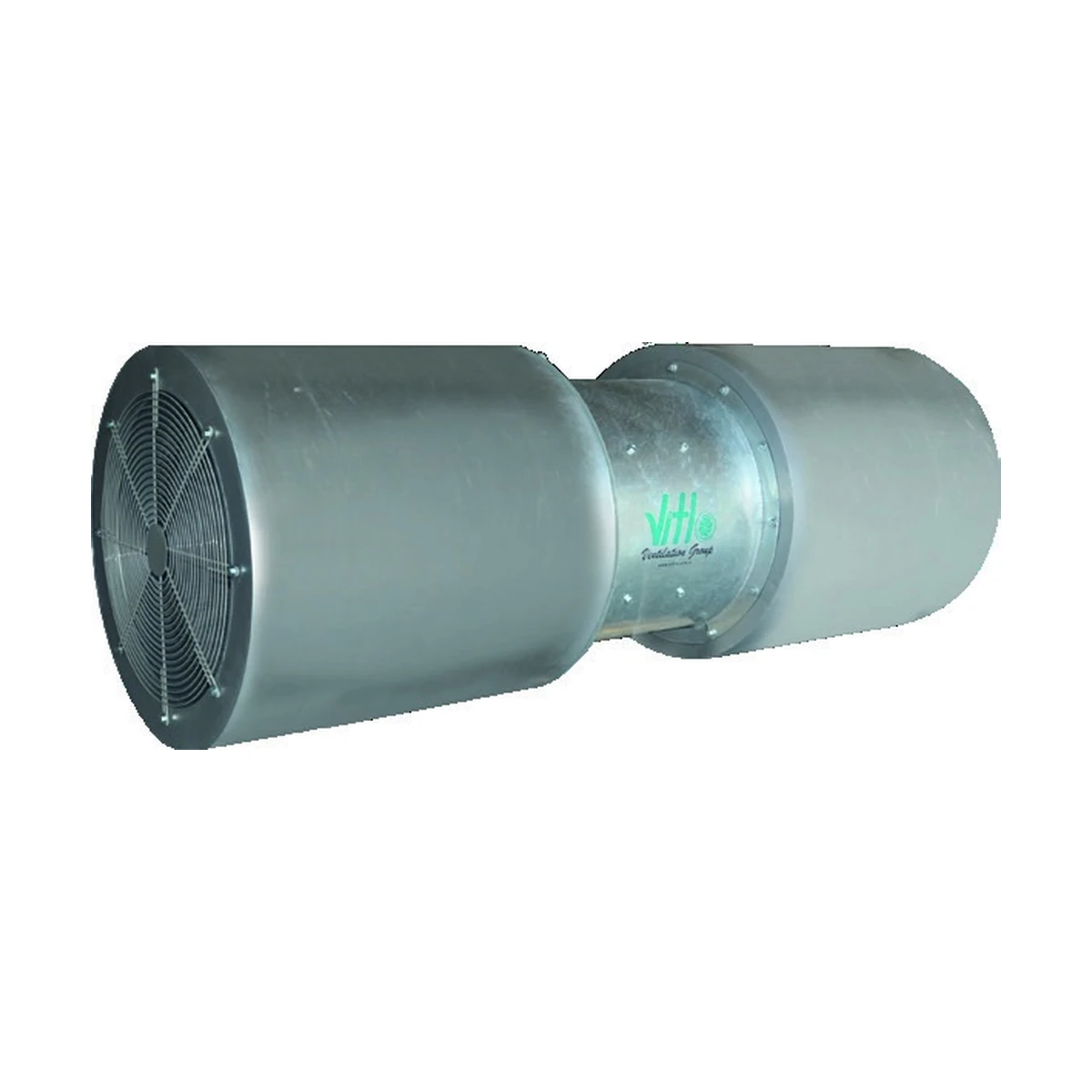
High-Thrust Jet Fan for Tunnels
The TUNEL-AXF series is a high-capacity axial fan solution developed for normal ventilation and emergency smoke-extraction scenarios in tunnels.
One project approach from normal ventilation to emergency smoke extraction.
We evaluate tunnel fan selection not only by airflow, but also by airflow direction, thrust, temperature resistance and the system scenario.
TUNEL-AXF product features
- General
There are different model options in the range of 560–1250 mm.
- General
It can be produced as double speed and reversible.
- General
With aerofoil section and adjustable angle, the blades are produced by aluminium injection casting.
- General
Both sides of the main casing are self-flanged without welding according to ISO 6580 / UNI-EUROVENT 1-2 standards.
- General
The fan casing is produced from hard steel and coated hot-dip galvanized as standard.
- General
The casing incorporates silencers on both sides.
- General
For S1 normal ventilation it is suitable for continuous operation from -20°C to +55°C.
- General
For S2 fire mode, 200°C/2h, 300°C/2h and 400°C/2h options are available.
- General
The fan is certified according to EN 12101-3:2015.
- Motor
The motor is IP55 protected, IE2/IE3 high efficiency, fully enclosed, with self-lubricating bearings and H insulation class.
- Motor
An external IP67 electrical junction box is provided outside the casing for easy electrical connection.
- Motor
It is 400V-50Hz as standard and suitable for use with a frequency converter.
Where is it used?
Model technical data
Nominal airflow alone is not a selection criterion. The final model must be verified together with the required thrust, pressure, operating direction, temperature resistance and mounting conditions.
| Model | Nominal airflow | Voltage | Motor power | Speed | Current | Sound | Thrust |
|---|---|---|---|---|---|---|---|
| TUNEL-AXF 56-2T-5,5 | 20,300 m³/h | 400V-50Hz | 4 kW | 2,910 rpm | 7.41 A | 62 dB(A) | 210 N |
| TUNEL-AXF 56-2T-7,5 | 22,500 m³/h | 400V-50Hz | 5.5 kW | 2,935 rpm | 10.3 A | 63 dB(A) | 240 N |
| TUNEL-AXF 63-2T-10 | 28,000 m³/h | 400V-50Hz | 7.5 kW | 2,920 rpm | 13.6 A | 64 dB(A) | 330 N |
| TUNEL-AXF 71-2T-10 | 35,000 m³/h | 400V-50Hz | 7.5 kW | 2,920 rpm | 13.6 A | 65 dB(A) | 370 N |
| TUNEL-AXF 71-2T-15 | 40,000 m³/h | 400V-50Hz | 11 kW | 2,950 rpm | 19.8 A | 67 dB(A) | 430 N |
| TUNEL-AXF 63-4T-4 | 20,000 m³/h | 400V-50Hz | 2.2 kW | 1,440 rpm | 4.61 A | 54 dB(A) | 135 N |
| TUNEL-AXF 71-4T-4 | 26,600 m³/h | 400V-50Hz | 3 kW | 1,440 rpm | 5.94 A | 57 dB(A) | 190 N |
| TUNEL-AXF 80-4T-5,5 | 34,100 m³/h | 400V-50Hz | 4 kW | 1,440 rpm | 7.62 A | 58 dB(A) | 230 N |
| TUNEL-AXF 90-4T-7,5 | 45,800 m³/h | 400V-50Hz | 5.5 kW | 1,470 rpm | 10.6 A | 60 dB(A) | 330 N |
| TUNEL-AXF 90-4T-10 | 52,000 m³/h | 400V-50Hz | 7.5 kW | 1,470 rpm | 14.2 A | 62 dB(A) | 425 N |
| TUNEL-AXF 100-4T-15 | 66,500 m³/h | 400V-50Hz | 11 kW | 1,470 rpm | 21 A | 65 dB(A) | 580 N |
| TUNEL-AXF 112-4T-20 | 74,000 m³/h | 400V-50Hz | 15 kW | 1,460 rpm | 28.4 A | 68 dB(A) | 720 N |
| TUNEL-AXF 112-4T-25 | 86,500 m³/h | 400V-50Hz | 18.5 kW | 1,475 rpm | 35.2 A | 67 dB(A) | 770 N |
| TUNEL-AXF 112-4T-30 | 92,500 m³/h | 400V-50Hz | 22 kW | 1,470 rpm | 42.4 A | 67 dB(A) | 933 N |
| TUNEL-AXF 125-4T-40 | 112,000 m³/h | 400V-50Hz | 30 kW | 1,475 rpm | 54.8 A | 69 dB(A) | 1064 N |
Source: Vensis Fan Selection Suite. Product, motor, fire resistance and operating direction must be verified for the ordered model.
Frequently asked technical questions
What does a tunnel fan do?
A tunnel fan supports air quality during normal operation and helps move smoke towards the designated extraction direction in an emergency. The fans are part of the tunnel’s complete ventilation and control scenario.
Can TUNEL-AXF operate reversibly?
The TUNEL-AXF series can be evaluated with a reversible-operation option depending on the project and model configuration. The final operating mode, motor and control scenario must be verified during technical selection.
What do F400 and EN 12101-3 mean?
The F400 class indicates the high-temperature operating resistance of the relevant product configuration, while EN 12101-3 defines performance requirements for smoke and heat control fans. The certification scope of the ordered model must be checked against the project specification.
How is the right tunnel fan selected?
Tunnel geometry, required airflow and thrust, pressure, operating direction, temperature resistance, sound level, mounting location and the emergency scenario must be evaluated together.
Is a tunnel fan the same as a car park jet fan?
Although their operating principles share similar elements, application geometry, thrust requirements, mounting, operating scenarios and certification conditions may differ. A tunnel project must therefore be selected separately according to its own technical requirements.
Request a quote for your tunnel fan project.
Share the tunnel length, cross-section, project airflow, required thrust, operating direction or fire scenario, and our technical team will contact you.